

Project for Second Year, Living Space Decor Project
Year: 2023
Location: National Institute of Fashion Technology, Hyderabad
Tools: Blender, Adobe Photoshop
Project completed under the guidance of
Prof. Uthaman. M.K., Department of Fashion and Lifestyle Accessories Design
Project Overview:
The project brief provided revolved around how one could design a space inclusive for both animals and humans. The secondary data navigated towards subjects of environmental history and evolutionary biology.
The project deals with how humans have come to have forgotten that the most inclusive space for all creatures is nature itself and how artificially built environments have left us with a dependency to survive, just as animals in a zoo are dependent on their keepers for survival.
Bringing awareness to these points, the VR gaming experience is designed using concepts of liminality and proportion to create feelings of being entrapped within a built environment for the user as they navigate their way out in a maze to a successful exit option that leads them to the wilderness.
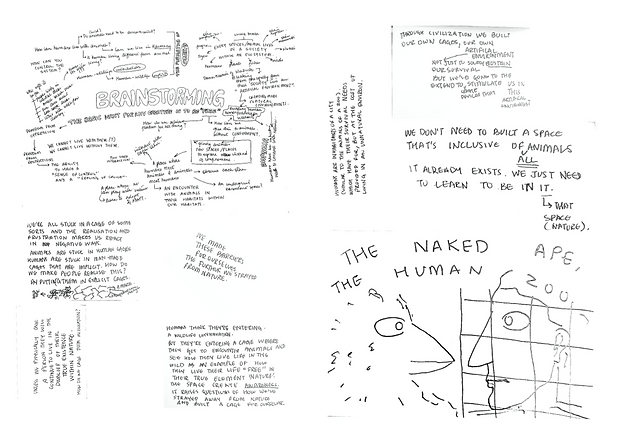
Brainstorming
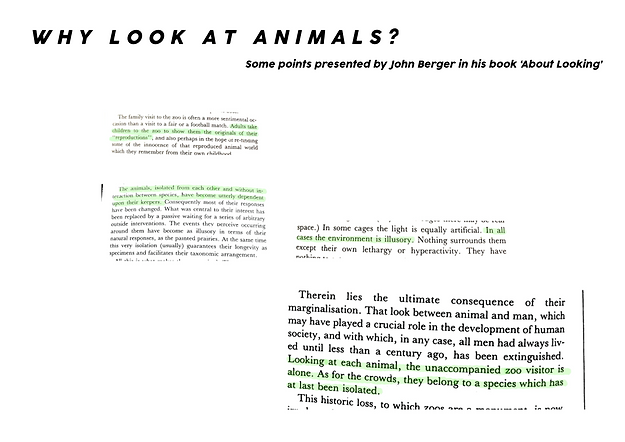
Certain points from 'About Looking' by John Berger
Research Summary:
Several literature pointed to the confinements of animals and the feelings of alienation felt in an artificially built environment by humans such as cages, zoos, or even fish bowls and tanks. Myriads of questions arose; how can humans and animals live in harmony, how does human habitation and lifestyle conflict those of animals, and most importantly; if the basic need of any creature is to be free, how can we give this "freedom" without confining them in built environments.
Literature shows that humans have deviated to live into artificially built environments, i.e, they have come to live in more advanced states of society compared to other animals. The only way to bring inclusivity for humans and animals is to either create awareness by providing context or to bridge the gap between built environs and nature.
Conceptualisation and Storyline:
A Virtual Reality game provides an illusionary space and acts as a good medium of communication to generate awareness while also providing entertainment.
The experience takes place at the last station of an underground metro station where the user is lead into a tunnel. The tunnel is built around the idea of being warped inside a liminal space where the environment emphasises on an “artificial space.” The user is left alone in this space to his own thoughts and confinement where they can dawn upon the sense of alienation and confinement whilst trying to figure out a way to get out of the space. However, the various exit options given at multiple points only lead them to an unescape cage in the wilderness. The game is built as a labyrinth that the user must solve by taking the right exit door.


Ideations for maze pathways


Explorations of spatial and proportional distortion for confinement cambers


Further explorations to understand the space
Outline of the Maze

Top view of the maze

Oblique view of the maze
Stage 1: Tunnel, a liminal space
The tunnel takes the user through a liminal space that acts as an emphasis on the “artificiality of the human environment.”
In the underground space, the area is scaled up to give a sense of being small in an artificial environment where the ceiling height is considerably taller than average and the width of the tunnel is also broader.


Wireframes of the underground tunnel

Image (1) Users view, Image (2) Comparative image of user proportion against the space
Stage 2: Exit Option
During the course of the game after certain turns, the user is provided with an exit option, questioning them if this is the exit they want to take,“Exit?”
At multiple intervals there is “The Wilderness” poster that is placed in intervals to create a sense of repetition.

"The wilderness is calling you! Won't you come back home?" poster


Wireframes showing exit tunnels

Visualisation of the exit option
Stage 3: Exit Lane, a transitional space
The exit lane proves as a transitional space within the liminality of the tunnel itself.
A space with dimmer lights, and an increased elevation taking the user from the underground to a higher ground.
A trapdoor situated at the top of the ceiling can be accessed by climbing the stairs that open into the cage or final game exit.


Wireframes of the tunnel

Visualisation of the tunnel
Stage 4: The Cage
The cage acts as a paradox to the human stuck within it while the rest of the animals and wilderness is left untamed and free.
The cage is a play on the "Wilderness" poster that previously asked the user "Won't you come back home?" and when the user does come to the wilderness, he is unable to free himself.
The cage has a very long ceiling and very little floor space to create a sense of confinement, making the user feel too large to fit in that space, by the use of distorting proportion.

Wireframe of the maze

Image (1) the users perspective, image (2) a comparative image of the users proportions against the space
Further Scope of Study:
The model of the maze above is derived from the 'Roma Labyrinth' structure. The complexity of the game could be improved and increased after every level by using more complex algorithms.
A stimulant such as an incentive could be included on the corse of the game or after it to study motivational patterns.
The medium of VR is a possibly beneficial method of using virtual space to create a non-disruptive space and also provide learning to users.
With the growth of new medias such as AR,VR, MR, & XR; there lies a chance in the future where one can live in a more natural habitat whilst still enjoying the comforts of which society provides us today. A place where social life is distinguishable from our existential life.