

Project for Third Year, Simple Design Project
Year: 2023
Location: National Institute of Fashion Technology, Hyderabad
Tools: Blender, Adobe Photoshop, Figma
Team: Hailey Thomas, Gauri Rathi
The project was completed under the guidance of Prof. Manpreet Kushwaha, Department of Fashion and Lifestyle Accessories Design
Project Overview:
This project was aimed at helping adolescents build resilience towards life problems by enhancing their spatial awareness. The VR game acts as a virtual diary that customises recreational spaces for the user to experience.
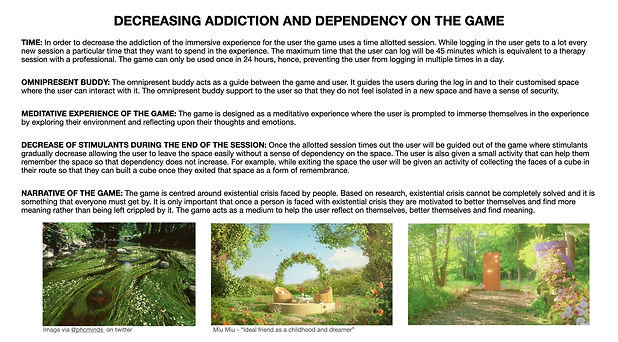
In each session, which consists of a maximum of 45 minutes per day, the user traverses new spaces where they can spend time exploring and performing tasks, i.e, diary entries, experiencing collective memories, and conversing with the Omnipresent Buddy.
The Omnipresent Buddy acts as a guide to the user while they explore new spaces and travel through different worlds. Each of the users experience can be charted and collected by them to be revisited later. The users progress will be tracked and can be used further by health professionals if needed.
Target Audience:
Based on the literature reviewed, the project shall be targeted to young adults between the age group of 18 to 25 years.
These mainly include undergrad and graduate students. This particular set of audiences was chosen as college and university life is when people often find themselves facing problems of rejection, failing, making wrong major life decisions, and not finding the right people or community.
SECONDARY RESEARCH:


PRIMARY RESEARCH:


RESEARCH ON VIDEO GAME THERAPY:

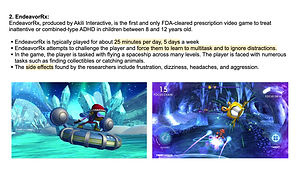


Existing video rehabilitation games


Existing AR & VR games
PERSONA STUDY:


EMPATHY MAPPING:

STORYBOARDING:

CHARACTER DESIGN:

INFORMATION ARCHITECTURE:

GAME ELEMENTS:

APP WIREFRAME:
The game can be accessed through a mobile app. The following is a simple user flow which starts with logging into an account. To start the game the user must pick a picture that resonates with how the user feels before starting the game. In the app the user will get introduced and will be guided by the omnipresent buddy; Halo.

Mid-fidelity wireframe for the app
STORYBOARDING FOR A USER:
A user from the previous group of students during primary research was re-interviewed and made to test the user flow of the game. Below are the accounts of the particular user and the spaces suggested for the user. This is presented as a storyboard to understand the user flow better.

User Information:
Age: 23 years
Gender: Female
Challenges faced: Academic stress, socialising with different people leaves her feeling drained, uncertainty of her future career.
Personality and how she handles problems: Being the youngest in a joint family, she tends to watch and learn rather than speak up. She likes thinking quietly, and this habit helps her deal with tough times. When things get rough, she usually turns to books. Reading lets her feel busy and helps her forget about her problems for a bit.
Based on the information collected the user was shown a group of images. On the basis of the image selected the user was provided two customised spaces as follows:
Customised space 1
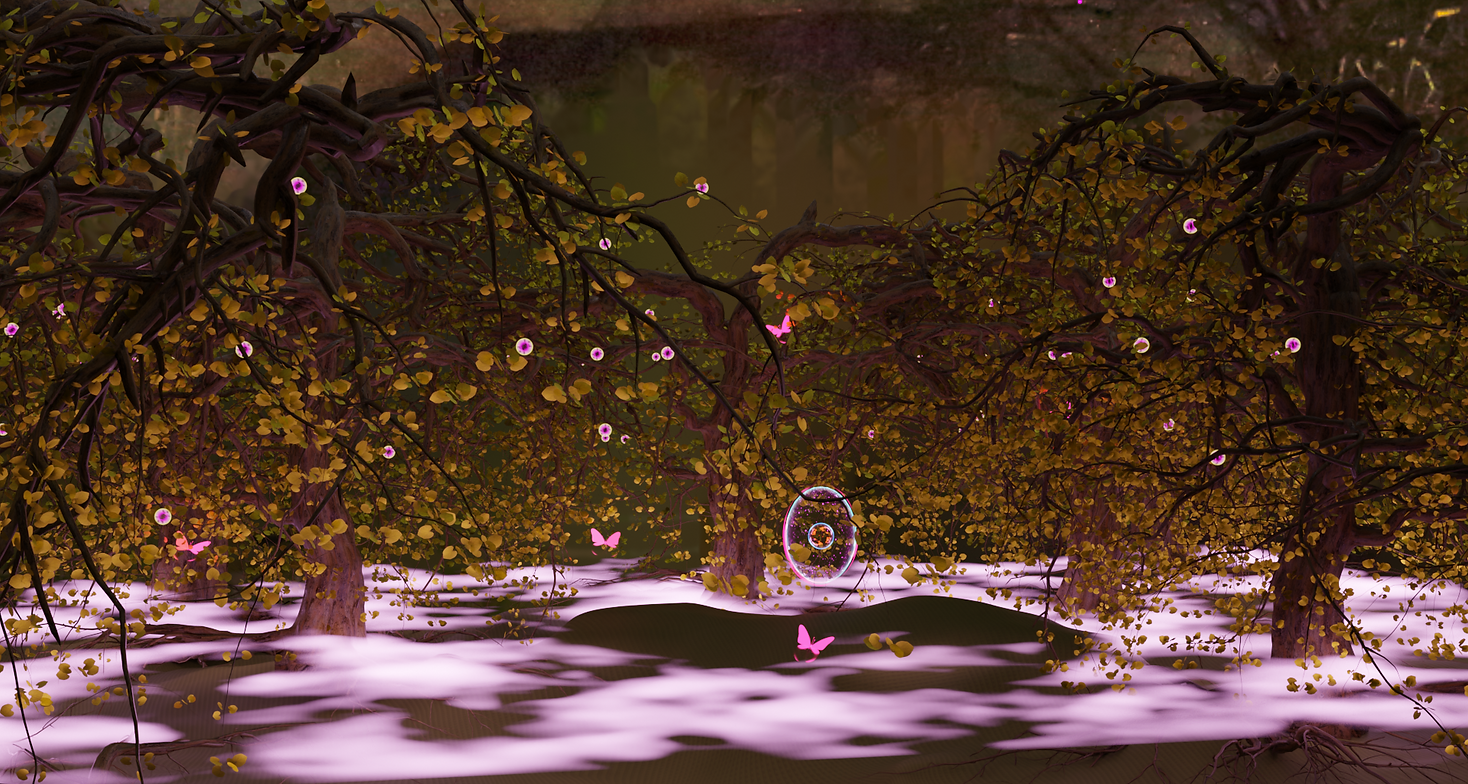
Customised space 2
FURTHER SCOPE OF STUDY:
Primary data collected: The primary data was collected from a total of 6 students regarding existential crisis and their self-concept during early adolescence and the transitional period of college. There was an equal distribution of students who came from contrasting upbringings. All the students interviewed were actively dealing with an existential crisis and prioritising their mental well-being.
We also interviewed Chandralekha Ghosle, a school counsellor with an experience of over 15 years and an educational background in counselling psychology. The project needs expertise of data scientists, CS engineers, sound artists, VR specialists, animators, lighting experts, and 3D modellers need to be included for the actualization of the project.
Mental Health Support: The game could incorporate evidence-based therapeutic techniques by collaborating with mental health professionals and institutions.
Ethical Considerations: Ethical concerns around privacy, data security, and the impact of immersive technologies on individuals with mental health conditions should be addressed.
Accessibility: The VR game should be accessible to a wide range of users, including those with different demographics.
Research and Development: Continuous research on user experience within VR space could contribute to a better understanding of how technological interventions like artificial intelligence and machine learning can help build resilience among users with an existential crisis and provide a better understanding of their motivational level in the game.
Personalised Experiences: Using machine learning and AI algorithms, the VR game could adapt its content based on individual user responses and needs, creating a customizable space. However, there are limits to the number of algorithms that can be incorporated into a system due to computational limitations and simplification by removing the algorithm may lead to the removal of certain features.